 -gazetkę

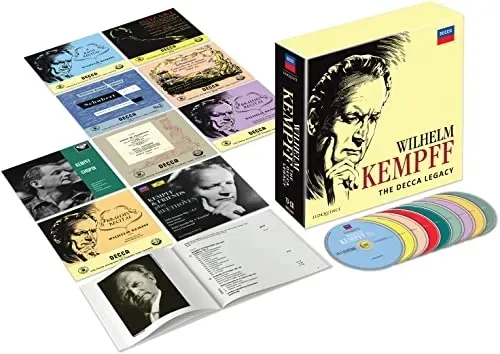
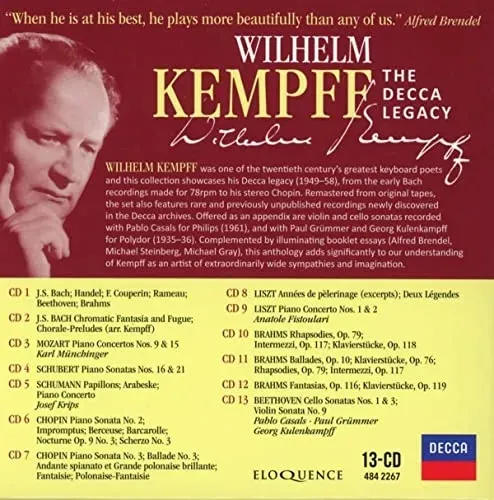
Wilhelm Kempff - The Decca Legacy
Parametry
- Stan
- Nowy
- Faktura
- Faktura VAT
- Rozmiar
- S
- Nośnik
- CD
- Wysokość
- 1 cm
- Szerokość produktu
- 11 cm
- Autor
- Wilhelm Kempff
- Wykonawca
- Wilhelm Kempff
- Tytuł
- Wilhelm Kempff - The Decca Legacy
- Rodzaj gadżetu
- muzyczny
- Tematyka, motyw
- inny
- Wytwórnia
- V Recordings
- Rodzaj
- inne
- Typ
- inny
- Gatunek
- pozostałe
Opis produktu
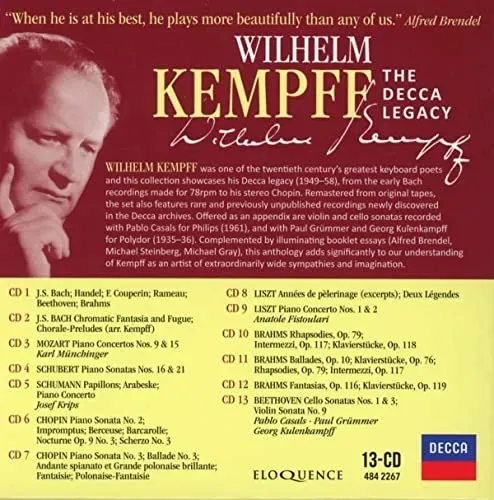
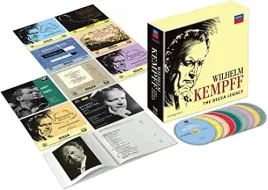
Wilhelm Kempff - The Decca Legacy
Opis:
The Decca legacy of WILHELM KEMPFF, one of the last centurys greatest keyboard poets. Wilhelm Kempff is known, with good reason, as a Beethoven interpreter of sublime simplicity, with several cycles of the concertos and sonatas to his credit, all of them recorded for DG. However, he began recording as early as 1918 and made records for Polydor before the war, as well as for Decca during the 1950s. While his DG recordings have rarely been out of the catalogue, his legacy on other labels has never been so comprehensively documented as it is on this newly remastered set from Eloquence. Offered as a historical appendix are Kempffs Polydor recordings of Beethoven sonatas with like-minded and recreative partners including the violinist Georg Kulenkampff (the Kreutzer) and the cellists Pablo Casals (Cello Sonata Op. 5 No. 1)and Paul Grümmer (Cello Sonata Op. 69), better known as a long-standing member of the Busch Quartet. These pre-war and mid-war recordings, newly remastered, add significantly to our understanding of Kempff as an artist of extraordinarily wide sympathies and imagination. The same could be said of his Decca legacy, which in its complete form should dispel the tenacious myth that he was first and foremost a Beethoven pianist. In 1950 he began recording the solo music of Brahms in the 78 era, with repertoire which he then recorded again in 1953 for LP. In the 1953 sessions he also recorded the composers late piano music, which is touched with an elusive grace that very few pianists find as surely as Kempff. Of interest to many will be previously unpublished material (Rameau, Brahms) as well as Kempffs first recordings for Decca of music by J.S. Bach, receiving their first release on CD. In the booklet essay for the box, Alfred Brendel explains how he particularly esteems Kempffs Decca recordings, for the piano sound captured at the companys studios in West Hampstead in London, and also how he prizes the pianists recordings of Liszt above all: truly legendary. He recalls seeing Kempff play Schuberts Sonatas D. 845, which Decca also captured, as an inspiration for his own subsequent dedication to the composers piano sonatas. A pair of Mozart concertos, KV 219 and KV 450, finds Kempffs phrasing at its most limpid and apparently effortless. His Decca discography concluded in fine style in 1958 with sessions which yielded three LP albums of Chopin. Several of these recordings have previously appeared in previous sets dedicated to Kempff but this is the first complete survey of his Decca legacy. Combined with the rare pre-war recordings, new remasterings and detailed editorial support (including a discographical essay by Michael Gray and one by the late Michael Steinberg), this set of Wilhelm Kempff will attract the attention of all pianophiles. When he is at his best, he plays more beautifully than any of us. (Alfred Brendel) The best I have ever heard A really startling achievement. Gramophone, July 1935 (Beethoven: Kreutzer Sonata) There is superb playing here a wonderful spontaneity and flow. Gramophone, January 1960 (Beethoven: Kreutzer Sonata) I have nothing but praise for this great pianists sensitive and musicianly playing. He catches perfectly the mood of every little picture in Papillons. Gramophone, July 1952 (Schumann) The Petrarch Sonnets are played with the intimacy that is needed, and passionate feeling that is never exaggerated. Gramophone, July 1952 (Liszt) This new recording by Mr. Kempff is in the same high class, and it has the distinction of a finely led and recorded orchestral performance, one that is exceptionally alive rhythmically. Mr. Kempff phrases most beautifully, with a winning simplicity and gentleness. High Fidelity, November 1953 (Schumann: Piano Concerto) Kempffs interpretation of these pieces is generally quiet and thoughtful. It has been well recorded, too. High Fidelity, March 1955 (Brahms: Ballades Op. 10) Whatever Kempff attempts, he accomplishe
Autor:Wilhelm Kempff
Nośnik:Audio CD
Płyt:
Język:
Data wydania: 2022-05-27
Waga: 0.89 gram
Wysokość: 1.5 cm
Szerokość: 5.3 cm
Długość: 5.3 cm
New Store Stock
UWAGA: Kupując produkt na tej aukcji zgadzasz się na wydłużony termin realizacji wysyłki (10-14 dni roboczych). Podany towar pochodzi z zagranicznego magazynu, stąd wydłużony czas realizacji który podany jest obok.